

Can AI Really Design Your Garden? The Problem With AI Garden Design
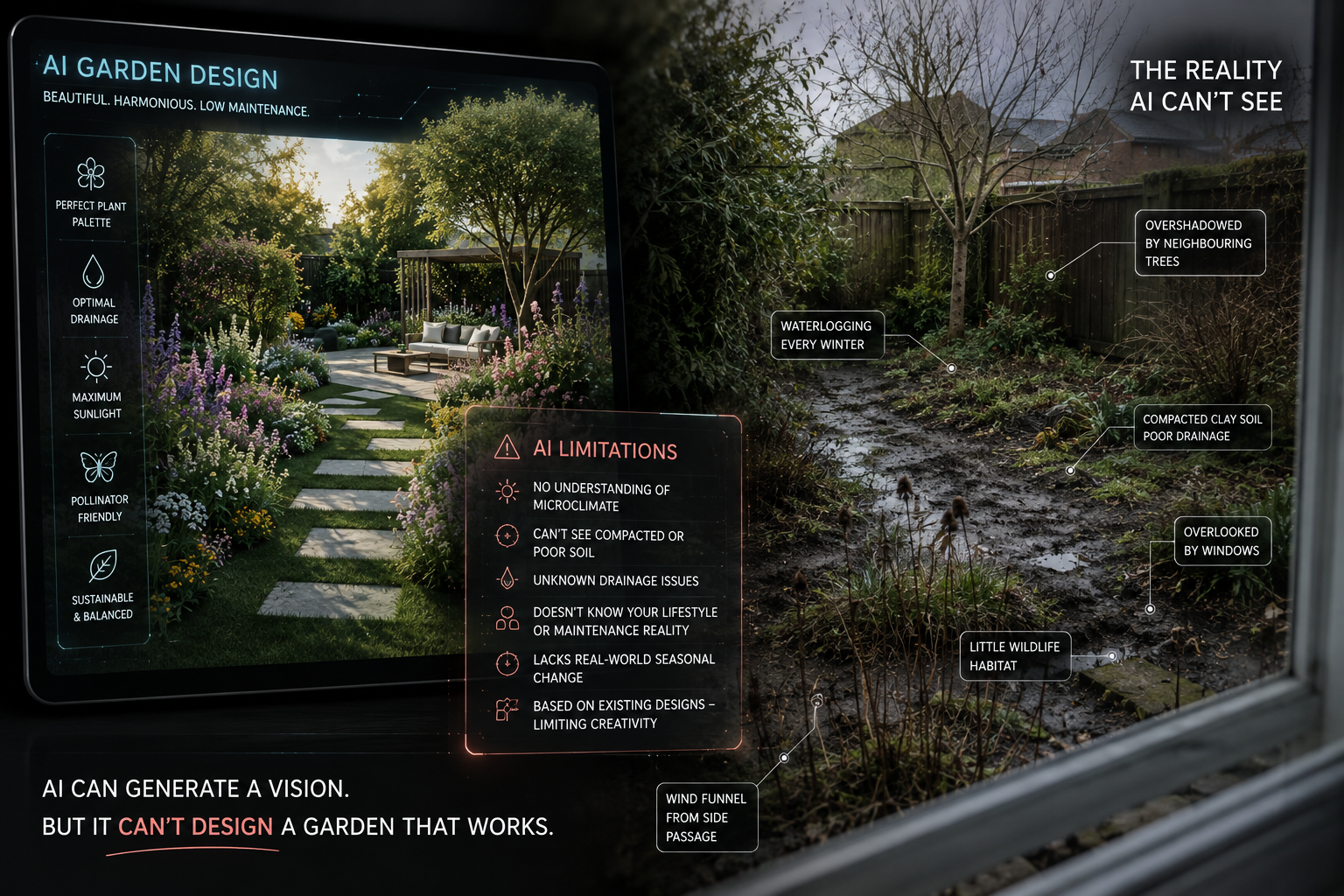
Yes, this image was created using AI
Artificial intelligence has arrived in the garden.
Search AI garden design today and you'll find tools promising to redesign your garden from a photograph, recommend plants, create planting schemes and transform an ordinary outdoor space into something resembling a professionally designed garden in seconds.
And I understand the appeal.
Upload a photograph. Choose cottage garden, contemporary, Mediterranean or wildlife garden. Wait a few seconds and suddenly you're looking at something beautiful.
But has AI actually designed a garden? Or has it designed a picture of one?
As a garden designer focused on biodiversity, wildlife-friendly gardening and sustainable garden design, that's where I become sceptical.
I was recently approached about becoming involved with an AI company developing a product around garden design. Ultimately, I chose not to move forward with it.
Not because I'm anti-AI. Far from it. I think AI could become an interesting tool for garden designers.
I simply wasn't convinced that an AI garden design tool aimed at the home gardener could currently understand enough about a real garden to design it properly, with nuance.
A garden isn't just a collection of plants and paving arranged beautifully. It's a living system, that evokes feeling and emotion, speaks to place and solves issues within an outdoor space.
AI garden design has arrived at Chelsea
AI has already made its way to the RHS Chelsea Flower Show.
In 2025, the Avanade Intelligent Garden, designed by Tom Massey and Je Ahn, became the first Chelsea Show Garden to harness AI. Importantly, AI didn't actually design it.
Instead, sensors monitored trees, soil conditions, sap flow, air quality and weather. Artificial intelligence analysed that information to help humans better understand what was happening within the garden.
To me, that's an exciting use of AI in gardening.
It isn't replacing horticultural knowledge. It's giving gardeners and designers access to information that would otherwise be extremely difficult to interpret.
By Chelsea 2026, however, the conversation had moved much closer to AI actually designing our gardens. Award-winning garden designer Matt Keightley launched Spacelift, an AI-assisted garden design platform aimed at homeowners, accompanied by three full-scale gardens at the show.
Unsurprisingly, it divided opinion. Some saw AI garden design as a way of making professional design principles available to people who couldn't afford a garden designer. Others questioned whether AI-generated design belonged at Chelsea at all.
Personally, I'm less concerned about AI stealing the garden designer's job. - Does AI stop an Artist painting? No.
I'm more interested in whether it can actually do the job.
A garden isn't an image
This is the fundamental problem I have with many current AI garden design tools.
AI is exceptionally good at producing images.
Give it a photograph of a lawn and fence and it can generate mature trees, beautiful perennial planting, natural stone paving and perfectly positioned garden furniture in seconds.
That's useful for inspiration.
But garden design isn't simply image-making.
When I first visit a garden, I'm looking at where the sun moves throughout the day. I'm noticing where water collects, where wind funnels between buildings, whether neighbouring trees create dry shade and whether the soil is clay, chalk, sand, compacted or filled with rubble.
I'm looking for frost pockets, changes in level, drainage problems and microclimates. I'm noticing neighbouring windows that overlook the space, borrowed views worth preserving and things we'd rather screen.
Then there are the people.
How do they actually use the garden? Where do they naturally walk? How much maintenance will they realistically do? Do they need somewhere for children, entertaining, wildlife, growing food – or all of the above?
AI can know that a particular plant prefers full sun and free-draining soil.
But does it know that the sunny-looking border in the photograph sits on compacted London clay and becomes waterlogged every February?
Not unless somebody tells it.
We don't garden in climate zones. We garden in places. Real, dynamic places.
And places are complicated.
Which creates another problem: does the average homeowner actually know what information they need to give an AI garden design tool in the first place?
And even if AI prompts them with the right questions, do they necessarily have the horticultural knowledge to read the land in front of them and answer accurately?
From my experience working with clients, the answer is often… No. Sorry, guys.
That's not a criticism of homeowners. Why would they necessarily know that a struggling hedge is telling us something about the soil beneath it, recognise the difference between shade and dry shade, identify a frost pocket or understand how the sun's path will change across the garden between January and July?
Reading a garden is a skill.
And if an AI garden designer needs a knowledgeable human to accurately interpret the site before it can produce a genuinely informed design, we haven't removed the need for garden-design expertise.
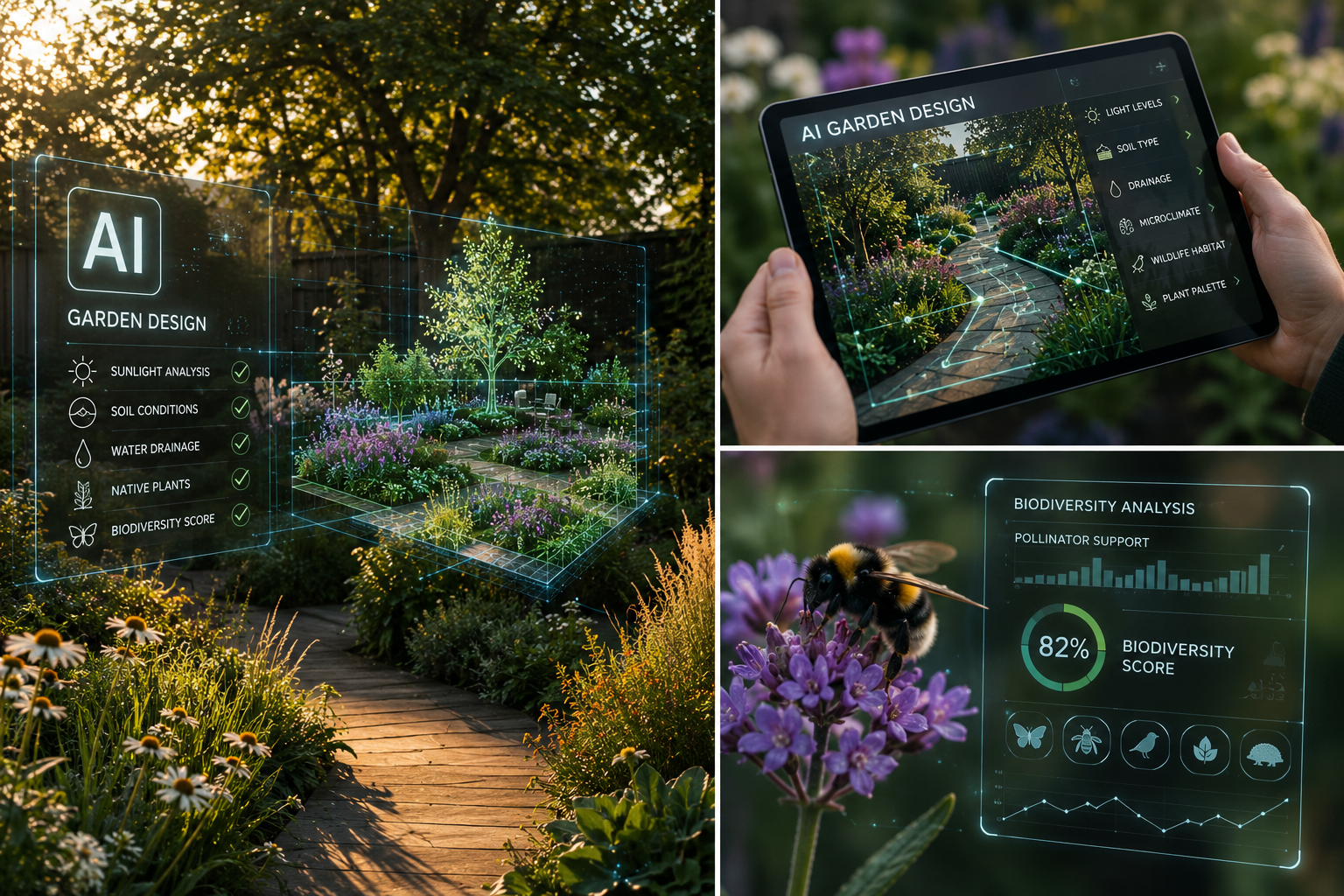
This image was created using AI
Can AI design a garden for biodiversity?
Can artificial intelligence create a beautiful garden?
Maybe?
But can it create a functioning ecosystem?
A genuinely wildlife-friendly garden isn't created by simply adding flowers labelled "pollinator friendly" by the RHS
Wildlife needs food, water, shelter and somewhere to reproduce. It needs different layers of vegetation, flowering across the seasons, healthy soil, dead material, seed heads, hollow stems and places to overwinter.
Some of the most ecologically valuable things in a garden may actually be the things an image generator learns to remove.
The dead wood disappearing beneath a shrub. Leaves decomposing underneath a hedge. Hollow stems left standing through winter. A slightly chewed plant. A patch of bare soil. A dense hedge that isn't clipped into perfection.
These aren't necessarily signs of a badly maintained garden. They're wildlife habitat.
And this raises a bigger question. If AI learns what a garden should look like from the gardens we've already created and photographed, does it really understand biodiversity?
Or does it simply understand what photographs labelled "wildlife garden" tend to look like?
Those are very different things.

Could AI make garden design less creative?
There's another issue I think deserves more attention.
If generative AI learns from what we've already designed, how do we use it to create what hasn't been designed yet?
Garden design constantly evolves. Designers challenge previous generations. Planting styles change. Materials change. Our understanding of ecology changes. And now climate change and biodiversity loss are forcing us to reconsider what our gardens need to do altogether.
Generative AI won’t copy existing gardens, but it does learn patterns from existing information.
Research into AI-assisted visual ideation has already raised the possibility of ‘design fixation’, where seeing AI-generated solutions can pull people towards particular ideas rather than encouraging completely independent exploration.
There is a danger that if thousands of us begin the creative process by asking similar AI systems for ideas, gardens gradually drift towards the same visual language.
The gardens we need in 2050 and beyond can not look or act like the gardens we've celebrated over the past 50 years due to our changing climate.
They may need to cope with greater heat, drought and extreme rainfall. They may need to provide significantly more habitat, require less irrigation and function as part of wider ecological networks.
The future of garden design cannot simply be a remix of its past.
The garden design isn't the garden
There's also something fundamentally unpredictable about gardening that an AI-generated plan can't eliminate.
Gardens are rarely built exactly as they're drawn. A landscaper excavates and discovers terrible drainage. A mature root is where a footing should go. A specified plant isn't available. A gardener moves something because, standing in the actual space, it simply works better somewhere else. Then nature gets involved.
Some plants thrive. Others disappear. Something self-seeds into a completely unexpected place and looks fantastic. A neighbouring tree comes down and suddenly your shade garden receives full sun.
None of this is a ‘mistake’ or bad, it’s the journey gardens take us on.
Even if AI could produce a perfect garden design tomorrow, somebody still has to interpret it.
A landscaper or gardener or horticulturist or homeowner or all of them!
And those people continue designing the garden long after the original plan has disappeared into a drawer.
So, can AI design your garden?
Increasingly, yes.
But I think we're asking the wrong question.
The real potential of AI in garden design may not be in replacing the designer at all. Its strength lies in its ability to process enormous amounts of information – soil data, rainfall, climate projections, flowering periods, wildlife relationships, water requirements and biodiversity – at a scale no individual person realistically could.
That could become an extraordinary resource for the garden design profession and for horticulture more widely.
But processing information and designing a garden are still two different things.
A garden designer brings judgement, creativity, observation, horticultural knowledge and, crucially, the ability to stand in the actual garden and understand what's happening. AI can process the data it's given. The harder part is knowing what matters, what has been missed and how all of those competing factors should influence the final garden.
That's why I chose not to become involved with an AI garden-design product aimed at the home gardener.
Not because AI has no place in gardening. I think it could have an enormous one.
But a garden isn't an image.
It isn't even a design.
It's an evolving relationship between plants, wildlife, soil, climate and people.
And for now, at least, that still requires something AI doesn't possess:
Someone to actually garden it.