

How to Keep Your Garden Alive During a Drought and Hosepipe Ban

London skyline from Richmond park - 18th August 2026
Gardening during a hosepipe ban and drought can feel like an impossible balancing act. Your plants need water, reservoirs are running low and suddenly reaching for the hose isn't an option. But drought gardening isn't simply about finding alternative ways to water your plants. Having spent years gardening in drought-prone Australia, I've learnt that the real answer is creating a garden that needs less water in the first place. From mulching and deep watering to rainwater harvesting and drought-tolerant planting, here's how to build a garden capable of surviving a dry British summer.
As I write this in August 2026, 71.3% of England is officially in drought. July was the driest July on record for England, receiving just 10% of its long-term average rainfall, while by mid-August England had received only 6% of the rainfall normally expected across the entire month. A growing number of water companies have introduced Temporary Use Bans — better known as hosepipe bans — across parts of England and Wales.
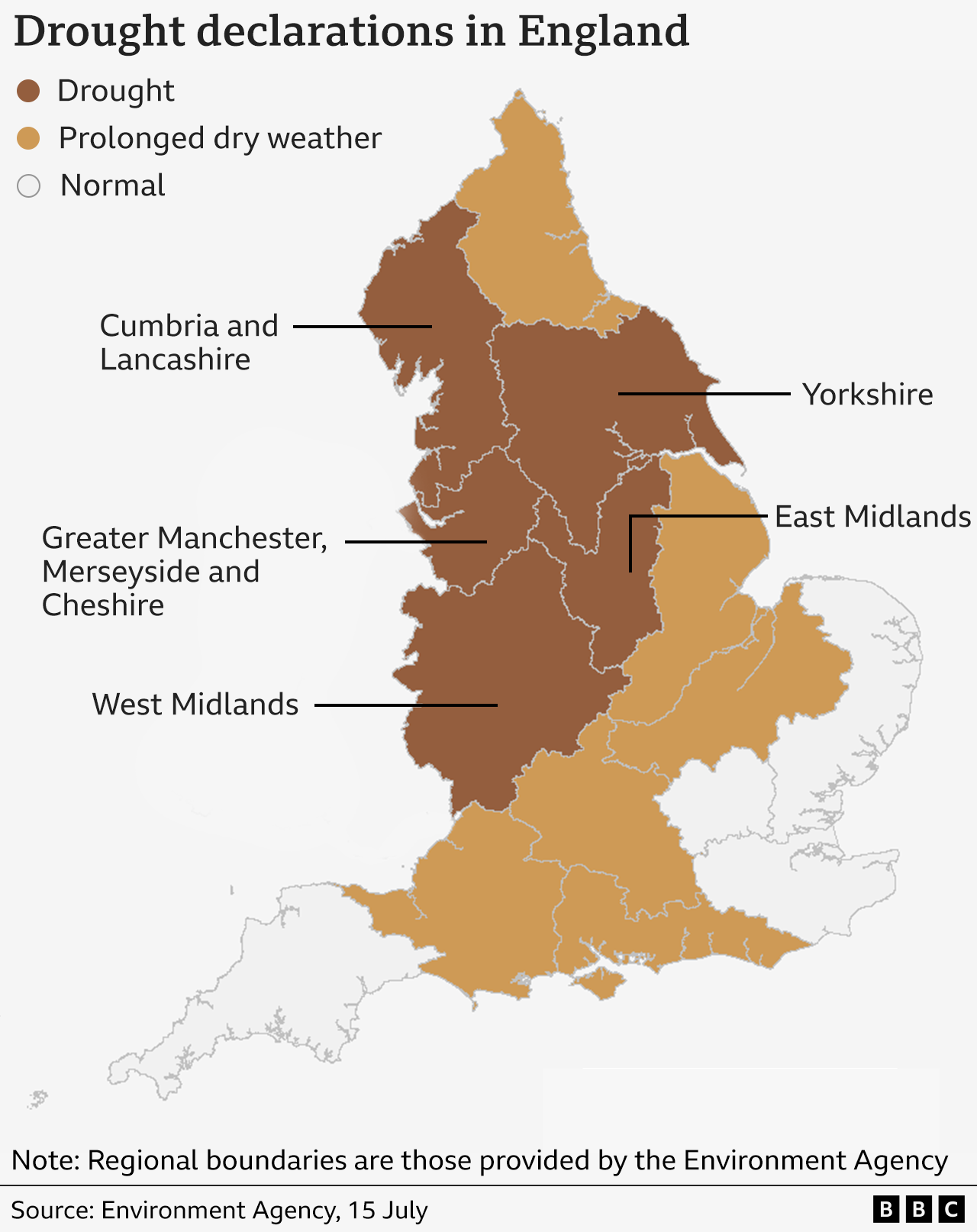
Cedit: BBC
At the same time, we're experiencing exceptional heat. Provisional Met Office figures for 1 June to 10 August put the UK's mean summer temperature at 16.48°C, 1.88°C above the 1991–2020 average, putting 2026 on course to potentially become the warmest UK summer on record.
For British gardeners, it can feel extraordinary. Coming from Australia, it feels rather more familiar.
I spent years gardening and designing gardens in Australia, where drought isn't treated as a freak occurrence. Water restrictions, weeks without meaningful rain and summers where keeping a garden alive becomes a genuine challenge are simply part of gardening in many parts of the country.
It teaches you something important: the answer isn't simply giving your garden more water. It's building a garden that needs less of it.
And increasingly, I think that's something British gardeners need to learn too.
1. Mulch Your Garden to Keep Moisture in the Soil
If I could make one change to the way we garden through increasingly dry summers, it would be to stop leaving so much soil exposed.
Bare soil is vulnerable to direct sunlight, heat and evaporation. Covering it with mulch helps insulate the soil and reduce moisture loss. Organic mulches such as garden compost, leaf mould, well-rotted manure and composted bark have another advantage: as they break down, they add organic matter and help improve the structure and water-holding capacity of the soil.
The RHS recommends a mulch of at least 5cm, and ideally around 7.5cm, for effective moisture conservation and weed suppression. It also notes that organic mulch can substantially reduce the amount of water a garden requires.
There is, however, an important caveat during a drought.
Don't throw a thick layer of mulch over bone-dry soil and assume you've fixed the problem. Mulch is most effective when applied to moist soil, locking in moisture that's already there. The RHS is currently recommending that gardeners hold off adding new mulch to established, drought-baked borders until rain returns, because a fresh dry layer can intercept light rainfall before it reaches the soil beneath. Newly planted trees and shrubs are an exception, provided they're thoroughly watered first.
So think of mulching primarily as preparation for the next drought, rather than emergency treatment for this one.
2. Britain needs to get more serious about harvesting rainwater
I love a water butt. But I also think we need to acknowledge its limitations.
The traditional UK water butt is fantastic for everyday gardening, but if Britain's summers continue becoming hotter and drier, a few hundred litres sitting beside the shed isn't necessarily going to carry a garden through weeks or months of drought.
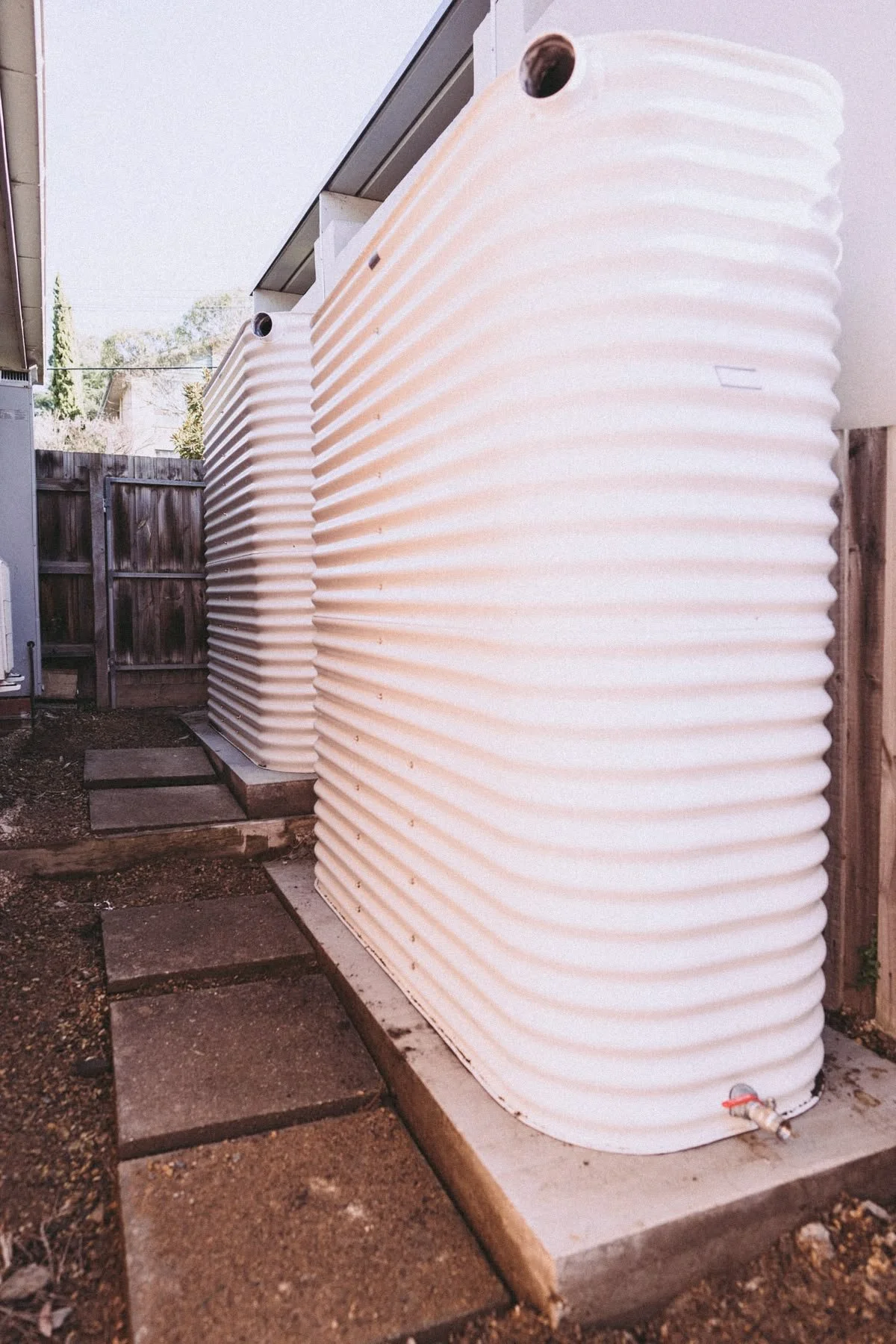
Ceddit: CONNIE CAO
In Australia, large rainwater tanks are commonplace. 10,000 litres isn't an extraordinary amount of water storage, and even tanks of that size can eventually run dry during prolonged drought.
That's the scale I think we need to start considering here.
Interestingly, this isn't just my Australian bias. The RHS's Gardening in a Changing Climate report specifically recommends improving water-capture infrastructure with greater capacity than standard water butts to provide water through increasingly challenging summers.
Rather than trying to get rid of winter rainfall as quickly as possible, imagine our homes and gardens as water catchments.
Roofs can feed tanks. Sheds and greenhouses can feed smaller butts. Overflow can move into rain gardens, ponds or planted areas rather than straight into the drainage system.
The water falling on our properties during winter could become a resource for the following summer.
3. Wean Your Garden Off Regular Watering
This is perhaps one of the most important lessons I brought with me from gardening in Australia: if you want a garden that can cope without constant watering, you have to allow it to learn how.
There can be a tendency to think that the more frequently we water a garden, the healthier it will be. But constantly giving plants small amounts of water can have the opposite effect in the long term.
Frequent, shallow watering keeps moisture concentrated near the surface of the soil. Roots have little incentive to explore deeper, leaving plants more vulnerable when the surface eventually dries out. Deep, less frequent watering encourages roots to grow further into the surrounding soil in search of moisture, creating plants that are better equipped to cope with periods of dry weather.
This begins when you're establishing the garden.
New plants do need regular watering. Their root systems haven't yet spread into the surrounding soil, so abandoning them immediately in the name of drought tolerance isn't going to make them tougher, it's probably going to kill them.
But as they establish, you can gradually increase the interval between watering.
Initially, that might mean watering very regularly after planting during warm, dry weather. As the roots begin to establish, move towards watering perhaps once or twice a week. From there, progressively increase the interval to only needed to do it when it hasn’t rained in a while or the plants look like they need it. Always taking rainfall, temperature, soil type and the individual plant into account.
Don't treat watering as a rigid calendar.
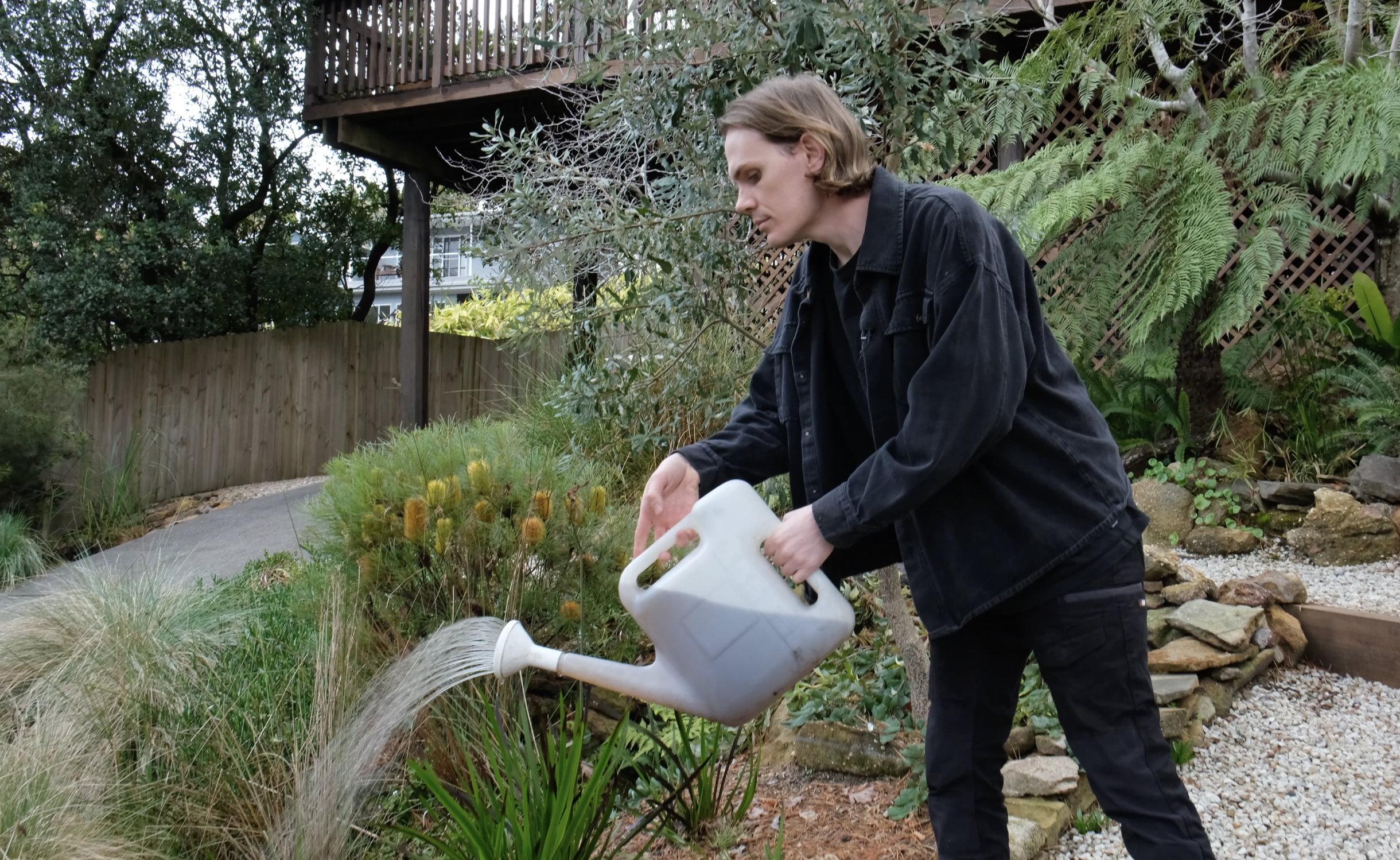
Don't give the surface a quick sprinkle. Water slowly and deeply, soaking the root zone properly before leaving the plant for a longer period. Allowing water to penetrate deep into the soil.
Over time, an appropriately planted and established garden should become increasingly capable of finding its own water. In fact, established trees, shrubs and perennials that have been chosen appropriately for their conditions should generally not require routine watering at all, except during particularly severe drought.
Combine that deeper root system with healthy soil and a good layer of mulch to reduce evaporation, and you begin creating something very different from an irrigated garden:
There are exceptions, of course. Containers will always dry out more quickly. Vegetables and fruiting crops can have much greater water requirements. Newly planted trees need particular attention, and plants growing in very sandy soils will behave differently from those growing in moisture-retentive clay.
But for an established ornamental garden, the goal shouldn't be to stand outside every evening with a hose.
The goal should be to eventually need the hose as little as possible.
That's the fundamental shift drought-conscious gardening requires. We don't just need to become better at watering our gardens. We need to create gardens that need less watering in the first place.
4. When Should You Water Your Garden During a Drought?
During a hosepipe ban, check the exact restrictions imposed by your water company, because rules and exemptions can vary. Where watering cans and buckets remain permitted, every litre suddenly becomes considerably more valuable.
Don't waste it watering leaves.
Apply water slowly and deliberately at soil level around the root zone.
The best time is generally early morning, when temperatures are cooler and evaporation is lower. Evening watering is also effective, particularly after the heat has gone from the day, although persistently wet foliage overnight can sometimes increase the risk of fungal disease.
And despite something many of us were probably told growing up, water droplets don't act like little magnifying glasses and burn holes through leaves. This is a big garden myth!
You should still avoid watering in the middle of a hot day — not because you'll scorch your plants, but because you're wasting water. Far more of it can be lost to evaporation before reaching the roots.
In a drought, efficiency matters.
5. Start Planting for a Hotter, Drier Climate
This is the longer-term conversation British gardening needs to have.
We can't necessarily continue designing every garden around the climate Britain had 30 or 40 years ago.
That doesn't mean ripping out your garden and replacing everything with agaves and eucalyptus. Nor does drought tolerance automatically mean Australian or mediterranean plants.
It means adopting the old principle of right plant, right place, with future climate conditions increasingly forming part of what we mean by "place".

Mediterranean plants are an obvious place to look. Plants adapted to regions of Australia, South Africa and other seasonally dry climates can also provide inspiration, provided they can tolerate your particular soil and, critically, a British winter. Some drought-tolerant plants cope brilliantly with summer dryness but fail in cold, wet winter soil. If looking for australian plants look for species that grow in the southern parts of australia like Victoria or Tasmania.
Britain also already has many plants capable of coping remarkably well with dry conditions.
The point isn't to create a desert garden, It's to gradually increase the proportion of your planting that doesn't collapse the moment rainfall disappears for a month.
6. Could a More Diverse Lawn Stay Green During Drought?
There's something interesting happening in our lawns during drought that is worth paying attention to. Walk through a park or look closely at your own lawn and you'll often see the traditional turf grasses have browned off, while little patches of green are still hanging on. Quite often, those survivors are the plants we've spent years calling weeds.
Clover, yarrow, selfheal and other broadleaf species can remain green long after some conventional lawn grasses have started to struggle. Their different root structures and growing habits mean a more diverse lawn doesn't necessarily respond to drought as one uniform carpet. Some species will retreat while others continue growing, creating a lawn that can be far more resilient overall.
Perhaps, then, we need to change our idea of what a "good lawn" looks like. Rather than expecting a perfect monoculture of grass, we could deliberately allow or introduce a greater diversity of low-growing plants. Clover, selfheal, yarrow, bird's-foot trefoil and other species can become part of the lawn rather than enemies within it.
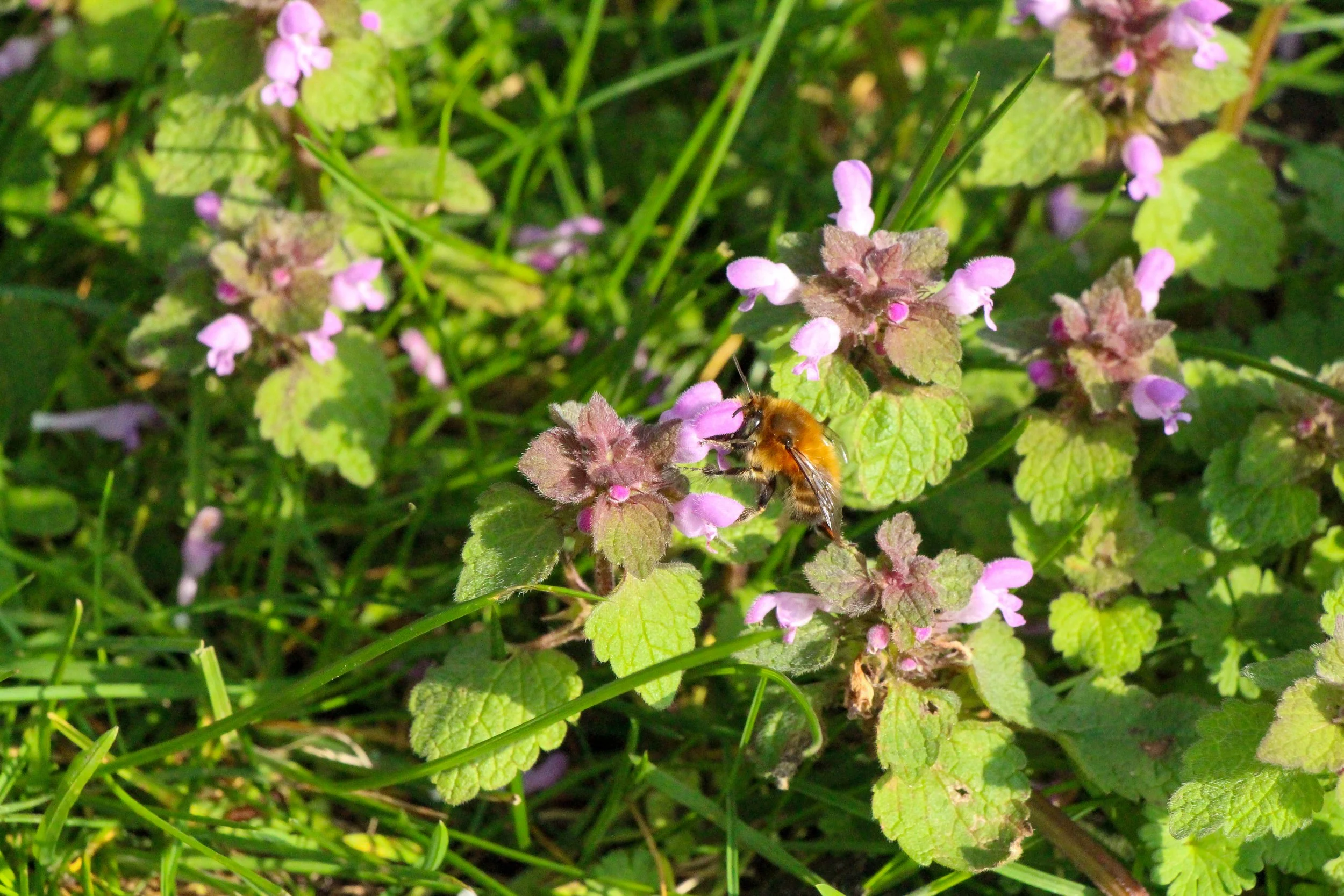
Red Dead Nettle in Lawn
You may not get the immaculate striped green carpet we've traditionally been taught to aspire to. But you could get something much more interesting: a lawn that stays greener with less water, supports far more biodiversity and is better equipped to cope with increasingly dry summers.
Sometimes drought doesn't just show us which plants are struggling. It shows us which plants should have been there all along.

7. Reuse Water Around the Home
We also need to get much better at seeing water as something that can have more than one life.
Some household greywater, such as water from washing up, baths or showers, washing machines, can be reused on ornamental plants rather than going immediately down the drain
There are sensible limitations. Greywater shouldn't be stored for long periods, and care is needed around edible crops and with products containing high levels of salts, bleach or harsh cleaning chemicals.
But during drought, a bowl of relatively clean water that would otherwise disappear down the sink can potentially become water for a thirsty ornamental plant.
Again, it comes down to changing the way we think about water.
The real lesson isn't how to survive this drought
Australia taught me that drought-proof gardening doesn't begin when the drought is announced.
It begins in autumn. And winter. And spring. Months and years before any sign of drought.
It's improving soil so that when rain falls, the garden can hold onto it.
It's applying mulch while the ground contains moisture.
It's capturing thousands of litres of winter rainfall instead of relying solely on drinking water in July and August.
It's choosing plants capable of surviving periods without irrigation.
And perhaps most importantly, it's watering less frequently from the beginning so plants are encouraged to establish properly rather than becoming permanently dependent on irrigation.
The UK is already experiencing increasingly extreme patterns of water availability. The Met Office observations show that UK summers are becoming warmer.
That doesn't mean every British summer will be dry. It doesn't mean every garden needs to become a dry garden either.
But it does mean we need to start designing and managing gardens with resilience in mind.
The gardens that cope best with drought aren't necessarily the ones being watered the most.
They're the ones that were prepared for drought before it arrived.