

Your Garden Matters: Introducing the Biodiversity Garden Blueprint
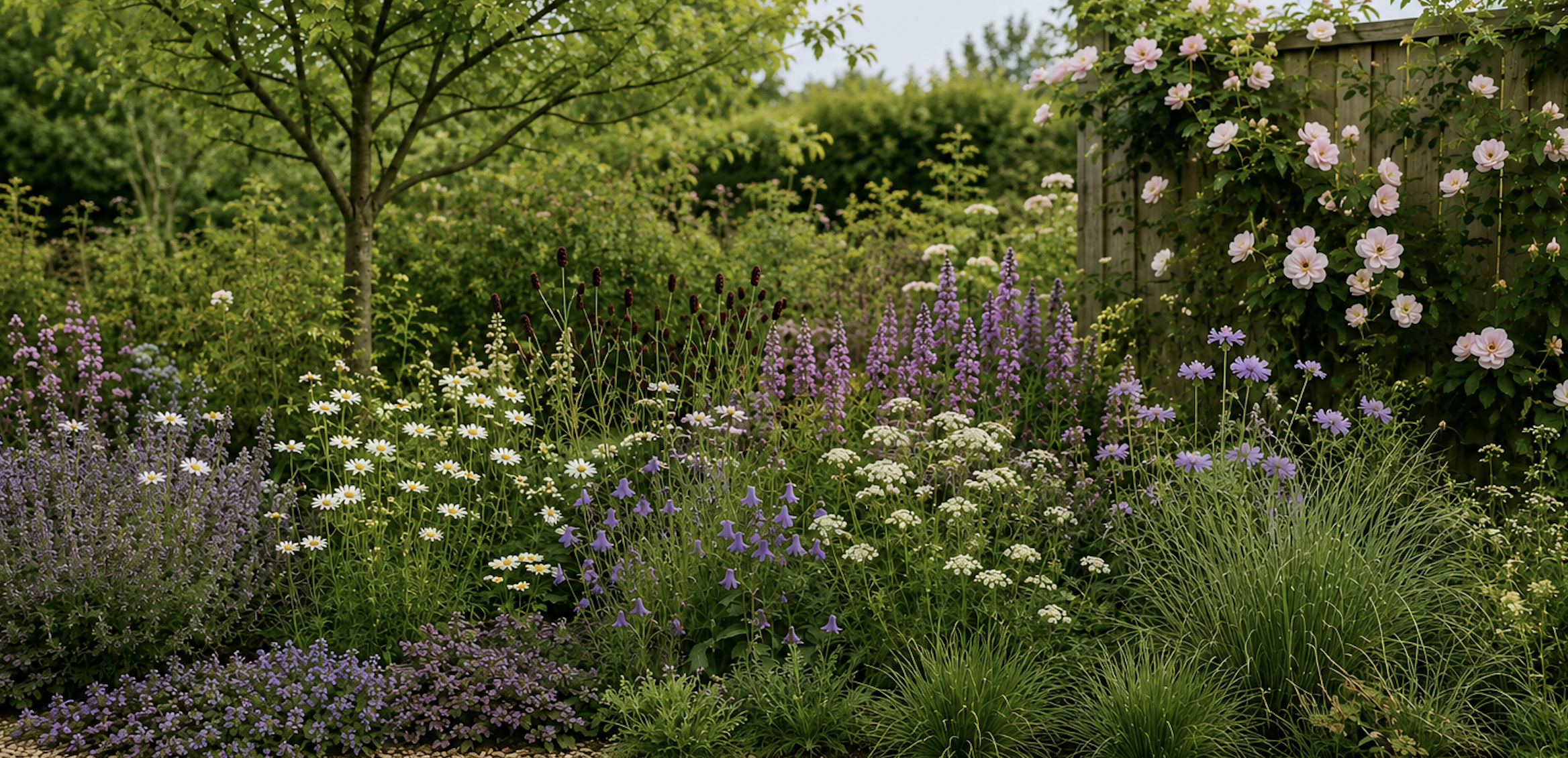
There are more than 25 million domestic gardens across Great Britain. Individually, they might be a few square metres behind a terrace, a suburban lawn or a collection of pots squeezed onto a patio. Together, they cover more than 900,000 hectares.
Suddenly, the humble back garden starts to look rather significant.
And at a time when British wildlife is facing extraordinary pressure, what we choose to do with all that space matters.
The State of Nature 2023 report paints a sobering picture. Across the UK, the abundance of species studied has fallen by an average of 19% since 1970. Nearly one in six species assessed is threatened with extinction from Great Britain, while pollinators including bees, hoverflies and moths have declined by an average of 18%.
It can make biodiversity loss feel like an enormous problem requiring equally enormous solutions.
But some of those solutions might be waiting just outside the back door.
The untapped potential of our gardens
New mapping by the Royal Horticultural Society has revealed just how substantial Britain's gardens really are. There are an estimated 25.8 million gardens covering around 959,800 hectares - 4.6% of Great Britain's total land area. Domestic front and back gardens alone account for more than half a million hectares.
These spaces are already important ecosystems. Research highlighted by the RHS suggests UK gardens support more than half of the nation's butterfly, amphibian and reptile species and more than 40% of its bird and mammal species.

Garden Designer Mykal Hoare
For garden designer Mykal Hoare, founder of The Gardener's Lodge, those numbers represent something gardeners often underestimate: collective power.
“I really don't think gardeners realise how much influence they can have on the world around them. One garden might seem insignificant, but when you start adding all of those gardens together, you're talking about an enormous amount of land.
“If we all thought a little harder about how our own spaces could support biodiversity, collectively we could have a huge impact.”
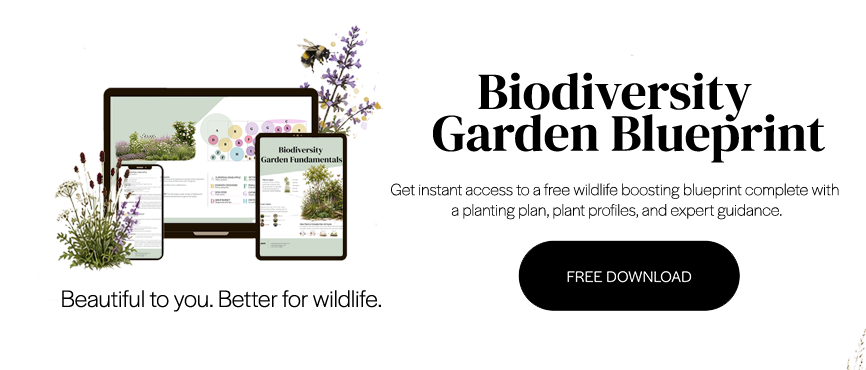
It was this idea that ultimately led Mykal to create the Biodiversity Garden Blueprint, a professionally designed planting scheme and practical guide that anyone can download for free and adapt to their own space.
But its beginnings also came from a certain frustration.
“I wanted to cut through some of the crap, really. There is so much jargon and confusion around creating a biodiversity garden. People want to help wildlife, but then they're faced with endless lists of plants and advice and they don't necessarily know how to turn all of that information into an actual garden.
“I wanted to give people something they could implement themselves and have confidence that the plants work together, that the garden will look beautiful and, importantly, that it will genuinely offer something to biodiversity.”
A biodiversity garden doesn't have to be messy
Mention wildlife gardening and certain images tend to appear: long grass, nettles, piles of logs and plants spilling into one another.
All can have tremendous ecological value. But the assumption that biodiversity and good design are somehow incompatible is one Mykal wants to challenge.
“I think one of the biggest misconceptions is that a biodiversity garden has to be messy, rough or somehow less designed. It doesn't.
“But I do think we have to challenge our perceptions a little bit about what a beautiful garden is supposed to look like. Why have we decided that completely manicured spaces are automatically more beautiful?”
Instead, he argues for gardens that allow plants to complete more of their natural lifecycle.
Flowers become seed heads. Roses develop hips. Perennials aren't necessarily cut to the ground the moment flowering finishes. Fallen organic material can be allowed to feed to the soil.
The result doesn't have to be chaos.
One increasingly influential landscape-design concept is Cues to Care: introducing recognisable signs of human intention around more naturalistic landscapes. A sharply defined border might contain looser planting. A clipped hedge might sit behind a wilder perennial scheme. Long grass can be intersected by a deliberately mown path.
“You can have something quite wild and naturalistic and then give it a beautiful sharp shovel edge border or maintain a clipped hedge behind it. Suddenly people understand that the wildness is intentional.
“For me, beautiful gardens are alive. They're natural, they're free, they have seed heads and rose hips and plants that are allowed to live out their lifecycle. That doesn't mean they can't also be stylish and beautifully designed such as a cohesive colour palette .”
Perhaps we've been gardening too much
The Blueprint also asks gardeners to think beyond plants.
Because simply filling a border with flowers labelled pollinator-friendly doesn't necessarily create a functioning ecosystem.
Wildlife needs food, water, shelter and habitat. Healthy soil needs organic matter and minimal disturbance. Birds need fruits, seeds and insects as well as somewhere to nest. Invertebrates need stems, leaves, dead wood and soil in which to complete different stages of their lifecycle.
Sometimes improving biodiversity isn't about adding something at all.
It's about doing less.
“Gardening has become incredibly commercialised. There's a product to solve this, another product to solve that. Your lawn needs to look absolutely perfect, so you're sold something to put on it.
“But if we take a step back, gardening is really just the stewardship of a space. That space can be as manicured or as wild as we like, but we don't have to constantly disrupt the soil or reach for chemicals to garden successfully.”
Instead, Mykal advocates thinking before digging, increasing plant diversity, feeding the soil, incorporating water, creating habitat and allowing wildlife to move between neighbouring gardens.
Even something as simple as a small opening at the bottom of a fence can connect otherwise isolated gardens and allow animals such as hedgehogs to travel through a neighbourhood.
A garden begins to function not simply as an attractive collection of plants, but as part of a much larger living landscape.
Twelve plants aren't going to save the world
The Biodiversity Garden Blueprint itself uses a palette of 12 UK native plant species selected to provide different resources and structure through the seasons.
But Mykal is deliberately cautious about presenting any planting plan as a magic formula for biodiversity.
“It's twelve plants. It's not the be-all and end-all of biodiversity, because ultimately we need diversity to create biodiversity.
“But imagine a thousand people implemented the design. Suddenly you've created a thousand new patches where there's pollen and nectar available, seeds and fruits for birds, places for wildlife to shelter and plants being allowed to complete their lifecycle.”
And the design is only one part of the Blueprint.
Alongside the planting plan are principles for managing the garden over time: building healthy soil, avoiding unnecessary pesticides, providing habitat and changing some of the maintenance practices that can inadvertently remove the very resources wildlife depends upon.
The design itself can also be adapted. It could become a border in a small urban garden, be repeated across a larger landscape or, with some adjustment, inspire planting in containers where putting plants directly into the ground isn't possible.
“I created it for everybody. The homeowner, the renter, somebody with a tiny garden or somebody with much more space.
“You don't need acres. You just need to be willing to give a little bit of your space back to nature.”
Why give it away?
The Biodiversity Garden Blueprint is the first in a growing collection of professionally designed Garden Blueprints from The Gardener's Lodge.
But this particular design is free.
That wasn't necessarily the original plan.
“As I was creating it, I realised that this one couldn't sit behind a paywall. I wanted it in people's hands.
“If somebody wants to make their garden better for wildlife, I don't want the first obstacle to be whether they can afford to buy a garden design. Download it. Use it. Adapt it. Take the principles from it and apply them somewhere else. That's the point.”
There is something refreshingly simple about that proposition.
At a time when biodiversity decline and climate change can feel impossibly large, planting a garden can seem almost laughably small.
One garden will not reverse biodiversity loss.
Neither will twelve plants.
But 25 million gardens present a very different proposition.
We all have a part to play
There will always be environmental decisions beyond the control of individual gardeners. Decisions about agriculture, development, emissions, conservation and land management ultimately require action far beyond the garden fence.
But that doesn't make what happens inside that fence irrelevant.
Quite the opposite.
“If there's one thing I want gardeners to understand about biodiversity, it's that we all need to get involved. We all have a part to play.
“The climate and biodiversity crises are happening around us. While politicians fight and squabble over targets and net zero, gardeners have something incredibly tangible available to us.
“We have the power to put plants into action.”
And perhaps responsibility doesn't need to feel burdensome.
A few more flowers. A little water. Healthy soil. A gap beneath the fence. Seed heads left standing through winter. Fewer chemicals. A corner allowed to become just a little wilder.
Maybe even a neighbour peering over the fence and asking why.
“If having a garden that's a little more biodiverse starts a conversation with your neighbour about why you're doing it, I think that's a win.”
Twenty-five million gardens won't change overnight.
But yours can start today.
Download the Biodiversity Garden Blueprint for free and start creating a garden that's beautiful for you — and valuable for everything that shares it with you.